How to Fit a Standing Desk Into a UK Box Room
Most standing desk advice assumes a home office bigger than most British flats. Here's how to actually measure, plan, and fit one into a box room.
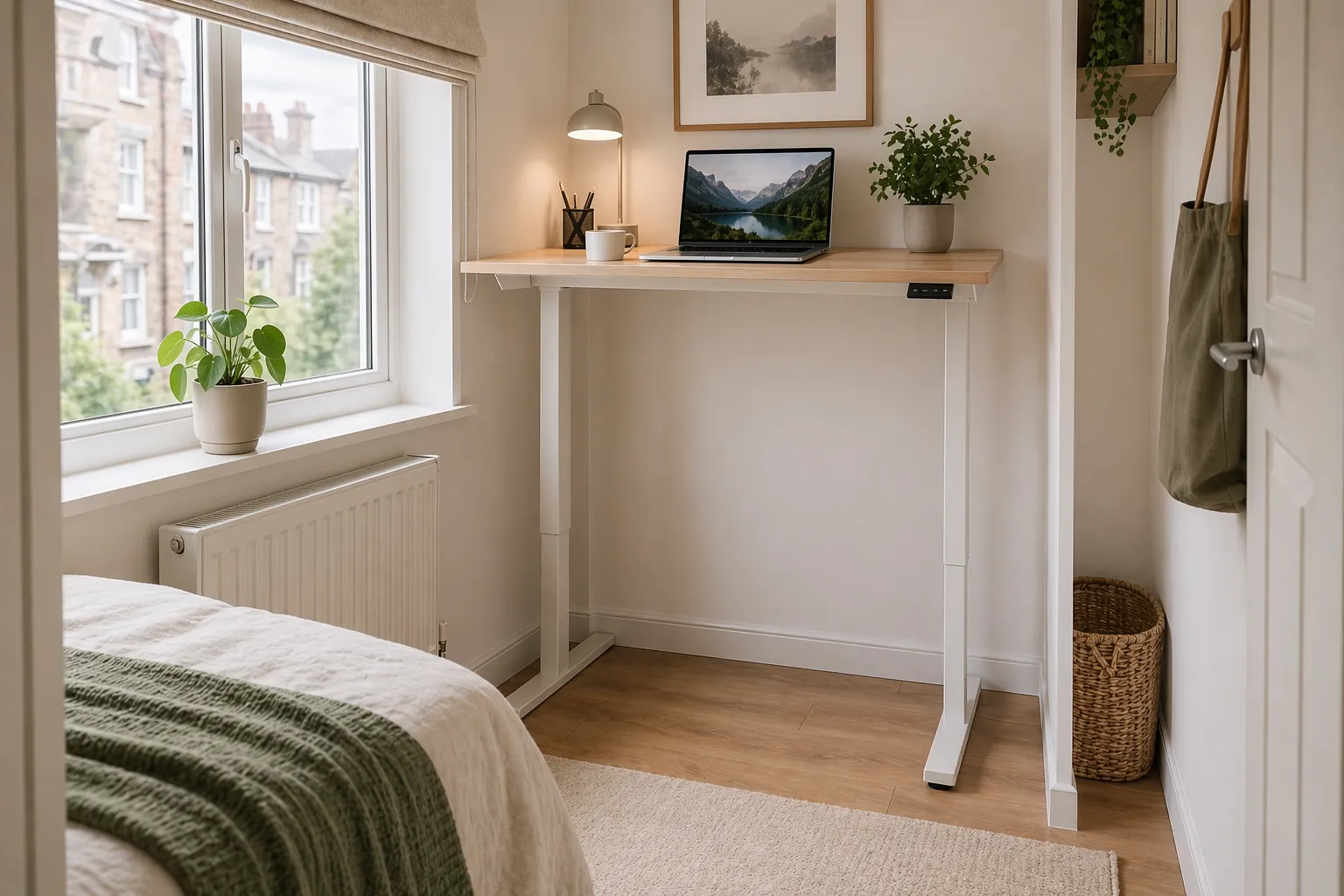
If you've tried to work out whether a standing desk will fit in your spare bedroom, you've probably noticed the same problem: most reviews and buying guides assume you've got a proper home office. Many desk reviews focus on 160cm widths in rooms that are bigger than a typical UK one-bed flat.
Actual British bedrooms don't work like that. Box rooms start around 2.2m on the short wall. A standard second bedroom is often 2.4m x 2.7m and has to contain a bed, wardrobe, radiator, and whatever else. If you're fitting a standing desk in alongside all that, the measurements matter more than the desk's stability rating.
This guide walks through the measurements you need to take, the gotchas most people miss, and how to translate a box-room floor plan into the right desk choice.
Start with the five measurements that actually matter
Grab a tape measure. Write these down:
1. Wall length (where the desk will go). Measure from wall to wall, or wall to obstacle (wardrobe, radiator, window trim). Take the shortest measurement if the wall isn't perfectly straight. Subtract 10cm for working clearance.
2. Room depth (in front of the desk). This is how far back your chair can roll. Minimum usable is 80cm from the desk edge. Less than that and you can't get up without shoving the chair into whatever's behind you.
3. Radiator position and depth. If there's a radiator on the desk wall, measure its distance from the wall (usually 8 to 12cm including the thermostat) and its width. The desk can't sit against the wall there.
4. Window sill height. If the desk is going under a window, measure from the floor to the sill. A standing desk at full height sits between 110cm and 125cm off the floor. If your sill is at 80cm, the raised desk will block the bottom third of your window.
5. Door swing. Measure the width of the doorway and the arc the door makes when opening. If the door opens inwards towards the desk wall, the desk can't sit in the path of the swing without blocking the door.
Once you've got those five numbers, you can actually shop.
The width decision
Most standing desks sell in 120cm, 140cm, 160cm, and 180cm widths. For a box room, the only two that matter are 100cm and 120cm.
100cm fits in a tight alcove or against a short wall with a wardrobe nearby. Single monitor setup, laptop docked to the side, keyboard and mouse. No second monitor without a stacked monitor arm. Good choice if your wall is under 150cm clear.
120cm is the sweet spot for a standard UK box room. Fits a 27 inch monitor in the centre with 20cm either side for a cup, a notebook, or a secondary laptop. Needs 130cm of clear wall minimum. This is the size used in the Flexispot E7 review, and it is the size most people should start with.
Anything wider than 120cm stops working in a box room. A 140cm desk leaves you with less than 80cm clearance from the opposite wall, which kills your chair movement.
The depth decision
Most standing desks are 60cm deep. Some go to 70cm or 80cm for dual-monitor setups. In a small room, 60cm is the right answer every time.
The trap is that desk depth interacts with chair clearance. A 60cm desk plus an 80cm chair space (60+80 = 140cm) needs 140cm of room depth before you hit the opposite wall. If your room is 240cm deep, you've got 100cm of space behind the chair for walking past, which works. If your room is 210cm deep, you've got 70cm, which is tight but liveable.
Don't buy a 70cm or 80cm deep desk for a box room. The extra depth doesn't give you much usable space (monitors sit at the back anyway), and it costs you more than it's worth in walking room.
Where the desk should actually go
Four options, ranked from best to worst for a UK box room:
1. Against the short wall, centred. Desk runs the width of the room, leaves equal clearance each side. Works for 2.4m to 2.7m rooms with a 120cm desk. The desk defines the "work end" of the room and doesn't fight with the bed.
2. In an alcove, beside a chimney breast. Found in older British properties. The alcove is usually 90cm to 110cm wide, perfect for a 100cm desk. Free side walls for monitor arms and cable management.
3. Against the long wall, between bed and wardrobe. Works if you've got a 120cm gap between other furniture, but you'll feel cramped because the desk is parallel to the bed. Your chair ends up facing sideways into the room.
4. Under a window. Only works if the sill is above 130cm. Otherwise the raised desk blocks your view. Light directly behind a monitor is also rubbish for eye strain, so this is a last resort.
The radiator problem
Most UK bedrooms have a radiator on one of the external walls, usually under a window. If your desk wall has a radiator, you have three options:
Skip that wall. Easiest. Move to a different wall.
Desk with clearance. Pull the desk forward so there's 10cm to 15cm between the back of the desk and the radiator. Heat escapes past the desk rather than baking the underside. You lose some depth from the room but keep the desk location.
Turn the radiator off permanently. If the room has central heating you can shut off the valve and rely on heat from elsewhere. This is fine in a flat with decent insulation. It's not fine in a draughty Victorian terrace in January.
Whatever you do, do not push a desk flush against a hot radiator. The chipboard will warp within a winter and the heat will escape upward into the underside of the desk instead of the room.
UK electrics: the bit most guides skip
A standing desk needs mains power. Your options:
Floor socket near the desk. Rare in UK bedrooms, but the best case. One short extension lead from the socket to the desk, done.
Wall socket on the desk wall. More common. You'll need an extension lead that can reach the raised desk position, because the cable travels with the desk. Measure from the socket to the desk height at its maximum (125cm) plus 30cm of slack. Most UK 4-way extension leads are 2m; that's almost always enough.
Wall socket on a different wall. Run the extension along the skirting board with cable clips. A 3m or 5m lead is standard for this. Avoid trailing cables across the floor where you walk.
A common mistake: buying a desk and realising the only nearby socket is already occupied by a lamp or a phone charger. Check this before you order. A £20 6-way extension with a switch per outlet is the right answer for any home office setup, and it lives on the floor behind the desk under a cable tray.
Getting the desk into the room
Standing desk frames are heavy and awkward. The frame alone weighs around 20kg. The desktop is another 15kg to 20kg. Boxes are usually 140cm to 180cm long.
Measure:
The front door. Standard UK internal doors are 76cm wide. Most flat-pack desk boxes fit through comfortably.
Stairs and landings. A 180cm box needs a full-length stairwell clear. Bends at the top of stairs are the killer. If you're in a flat with a tight landing, measure the angle before you order.
Lift size, if you're on an upper floor. Most UK flat lifts are smaller than you'd think. A 180cm box often won't fit diagonally. If the lift is too small, you're carrying the box up the stairs.
If the box won't fit, you're looking at either a smaller desk, self-assembly kits that ship in more compact packaging, or paying for white-glove delivery that can navigate stairs.
Standing height: can you actually stand at your desk?
This is the question nobody asks before buying. Standing desks raise to between 115cm and 125cm at the top end. For that to be comfortable, you need roughly the same height of clear headroom plus the height of whatever's on the desk.
Monitor at eye level means the top of the monitor sits around 155cm to 165cm off the floor when you're standing. Add a monitor light bar on top of that and you're at 170cm. Ceiling height in most UK bedrooms is 240cm, so there's no practical issue. In a loft conversion with a sloped ceiling, it's a different story.
The other thing to check: ceiling lights. If you have a pendant light hanging over the desk area, it'll be in your face when you stand. Swap to a flush fitting before you install the desk.
Matching room size to desk choice
Rough rule of thumb, assuming a single-monitor setup:
| Short wall length | Desk width | Desk to look at |
|---|---|---|
| Under 130cm | 100cm | VASAGLE LWD045 fixed-height or a smaller Flexispot desktop |
| 130cm to 160cm | 120cm | Flexispot EF1 (budget) or Flexispot E7 (stability) |
| 160cm to 200cm | 120cm or 140cm | Flexispot E7 at 140cm width |
| Over 200cm | 140cm+ | Any desk, you're not actually in a box room |
A note on fixed-height vs standing
Electric standing desks cost £200 to £400. A good fixed-height desk costs £50 to £100. Before you commit to the standing desk budget, be honest about whether you'll use the standing function. Most people don't, after the first month.
If you've never stood at a desk before, try it before you buy. Stand at a kitchen counter for an hour with your laptop. If you hated it, you don't need a standing desk. Get a VASAGLE or similar fixed-height and spend the £200 saved on a better chair or a monitor.
If you genuinely use the standing function (ideally for 30 to 60 minutes a few times a day), the health and focus benefits are real and the desk pays for itself in posture alone. Starting point for most small-space setups is the EF1; stretch to the E7 if your budget allows and you want the stability at full height.
The five-minute version
If you just want the checklist:
- Measure your short wall (minus 10cm clearance)
- Aim for a 120cm desk in a standard box room, 100cm in a tight one
- Check radiator position and plan for 10 to 15cm clearance if needed
- Check your nearest socket can reach the raised desk with a standard 2m extension
- Measure your door and stairwell before you order
- Start with the cheaper option (EF1 or fixed-height) unless you know you'll stand daily
Do those six things and the desk will fit the room. Do none of them and you'll end up re-selling a 160cm desk on Gumtree.
Where to go next
Continue from this article into the most relevant compact setup guides, reviews, and hubs.
Hub
Small desk hub
Start with compact desk reviews and guides grouped by room size and setup type.
Read next
Hub
Small office chairs hub
Compare chairs for small desks, bedroom corners, and tuck-away setups.
Read next
Hub
Monitor arms and desk accessories hub
Find monitor arms, laptop stands, lights, keyboards, and cable fixes for compact desks.
Read next