80cm Desk Setup Ideas For Small Bedrooms
How to build a usable 80cm desk setup in a small bedroom with the right chair, monitor arm, lighting, and cable layout.
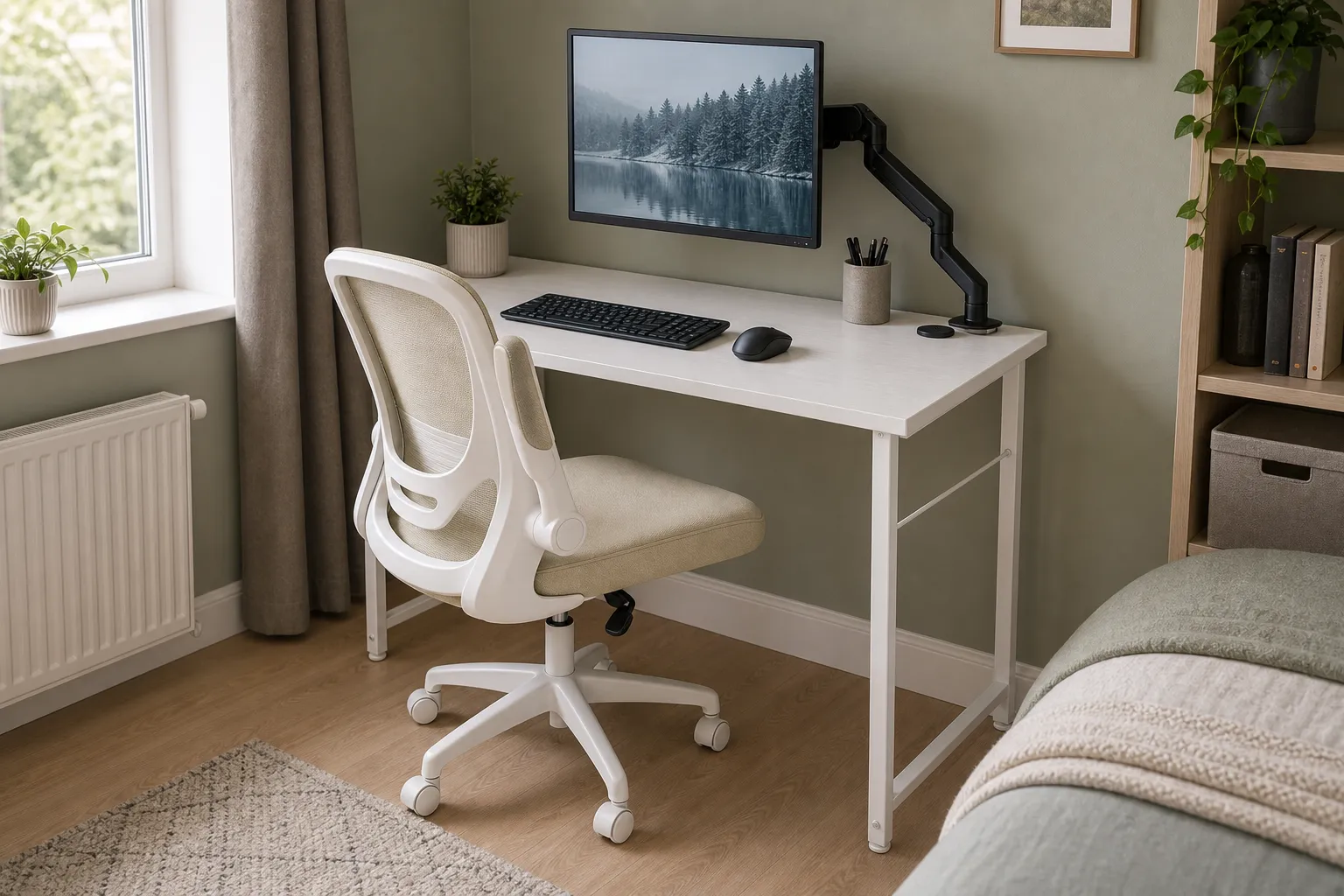
An 80cm desk is not a miniature version of a normal home office. It is its own category. The setup only works when every item earns its space.
That does not mean an 80cm desk is a bad idea. In a small bedroom, student room, or box room, it can be the difference between having a proper work surface and having no desk at all.
The trick is to stop building the setup like a full-size office. Use the desk for the essentials, move anything bulky off the surface, and choose a chair that can disappear under the top when work is done.
Start with the right expectations
An 80cm desk is best for one focused setup:
- laptop work
- laptop plus external keyboard and mouse
- one monitor on an arm
- study, writing, admin, and video calls
It is not ideal for dual monitors, large speakers, paperwork piles, or a tower PC on the floor beside your knees. If the room can take a 100cm desk cleanly, read 80cm vs 100cm Desk: Which Is Better for a Small Room? before committing to the smaller size.
If 80cm is the real limit, the setup below is the most reliable way to make it work.
The simple 80cm desk formula
The most useful 80cm desk setup has four parts:
- A narrow desk that keeps the room passable.
- A compact chair with arms that lift or fit under the top.
- A monitor arm or laptop stand to lift the screen.
- A separate keyboard and mouse so your shoulders are not dragged forward.
That combination gives you a proper typing position without turning the bedroom into an office full time.
Pick a desk that does not pretend to be bigger
A desk like the ODK 80 x 40cm desk works because it accepts the constraint. It gives you a light frame, a narrow top, and just enough surface for a laptop-first setup.
Recommended retailer Check the ODK 80 x 40cm desk on AmazonTypical price £20. Opens in a new tab. Check current priceAt 40cm deep, it needs careful planning. A laptop can sit directly on the desk. A monitor should usually go on an arm. A deep monitor stand will take too much of the surface and force the keyboard towards the front edge.
Keep the desktop simple:
- laptop or monitor
- compact keyboard
- mouse
- one notebook
- one lamp or clamp light
Everything else should live on a shelf, in a drawer unit, or in a cable basket.
Use a chair that tucks away
Chair clearance is the hidden measurement people forget. An 80cm desk might fit the wall perfectly, but the chair still needs space to roll back, turn, and clear the bed.
A chair with flip-up arms, such as the SONGMICS OBN037K03, helps because the arms do not catch on the desk edge when the chair is pushed in.
Recommended retailer Check the SONGMICS OBN037K03 on AmazonTypical price £56. Opens in a new tab. Check current priceFor small bedrooms, look for:
- a light-coloured frame if the room is already visually busy
- armrests that lift or sit low enough to clear the desk
- a caster base that fits the floor space
- seat height that works with a fixed desk around 73cm high
The chair does not need to be tiny. It needs to be easy to park.
Put the screen on an arm if you use a monitor
A monitor arm is one of the best small-desk upgrades. It gives back the space normally lost to the monitor stand and lets the screen sit further back.
The HUANUO HNSS6 is a budget-friendly example for compatible 13 to 32 inch monitors with 75 x 75mm or 100 x 100mm VESA mounting.
Recommended retailer Check the HUANUO HNSS6 on AmazonTypical price £28. Opens in a new tab. Check current priceBefore buying any monitor arm, check:
- your monitor has a VESA mount
- the monitor weight is within the arm's range
- the desk edge can take a clamp
- there is enough room behind the desk for the arm to move
On an 80cm desk, mount the arm at the rear corner or rear centre, then keep the keyboard directly in front of the screen.
Keep the typing position central
HSE guidance for display screen equipment recommends assessing the whole workstation, including the screen, keyboard, furniture, and working conditions. For a tiny desk, the practical aim is simple: keep the screen and keyboard central, keep the screen at a comfortable distance, and avoid dragging the mouse too far to one side.
That is harder on an 80cm desk because the mouse can easily drift too far right. A compact keyboard helps more than almost anything else. Removing the numpad can reclaim enough mouse room to keep your shoulders square.
For a laptop setup, do not work for long periods hunched over the built-in keyboard. Use a laptop stand or raise the laptop, then add a separate keyboard and mouse.
Control cables early
Cable mess looks worse on a tiny desk because there is nowhere for it to hide. Keep the setup boring and deliberate:
- run laptop power down one rear corner
- clip the monitor cable to the arm
- use a short keyboard or charging cable where possible
- keep a small extension lead off the floor if the room allows it
A cheap stick-on cable clip can do more for an 80cm setup than another desk accessory.
Use vertical storage, not desktop storage
Desk organisers are often too big for a shallow desk. Use the wall or the side of the room instead.
A narrow shelf above the desk can hold notebooks, pens, a webcam, or a small plant. A bedside drawer unit can hold chargers and stationery. A wall hook can keep headphones away from the desktop.
The surface should stay clear enough that the keyboard can move back when you need writing space.
The best 80cm desk layout
For most small bedrooms, the best layout is:
- Desk against the wall, not floating into the room.
- Monitor arm clamped at the rear corner.
- Keyboard and mouse centred below the screen.
- Chair tucked fully under the desk when not in use.
- Lamp on the window side or clamped to the desk edge.
- Cables routed down the rear leg.
That setup keeps the room usable after work, which is the real test. A small desk is only successful if the bedroom still feels like a bedroom.
Bottom line
An 80cm desk setup works when it is honest about space. Keep the surface simple, lift the screen, use a chair that tucks away, and move storage off the desktop.
The result will not feel like a full office. That is the point. It gives you a proper place to work without letting the desk take over the room.
Where to go next
Continue from this article into the most relevant compact setup guides, reviews, and hubs.
Hub
Small desk hub
Start with compact desk reviews and guides grouped by room size and setup type.
Read next
Hub
Small office chairs hub
Compare chairs for small desks, bedroom corners, and tuck-away setups.
Read next
Hub
Monitor arms and desk accessories hub
Find monitor arms, laptop stands, lights, keyboards, and cable fixes for compact desks.
Read next