How Much Space Do You Need Behind a Desk for a Chair?
Allow about 75cm for a chair in use and 90cm or more for a comfortable route behind it. Here is how to measure a compact room properly.
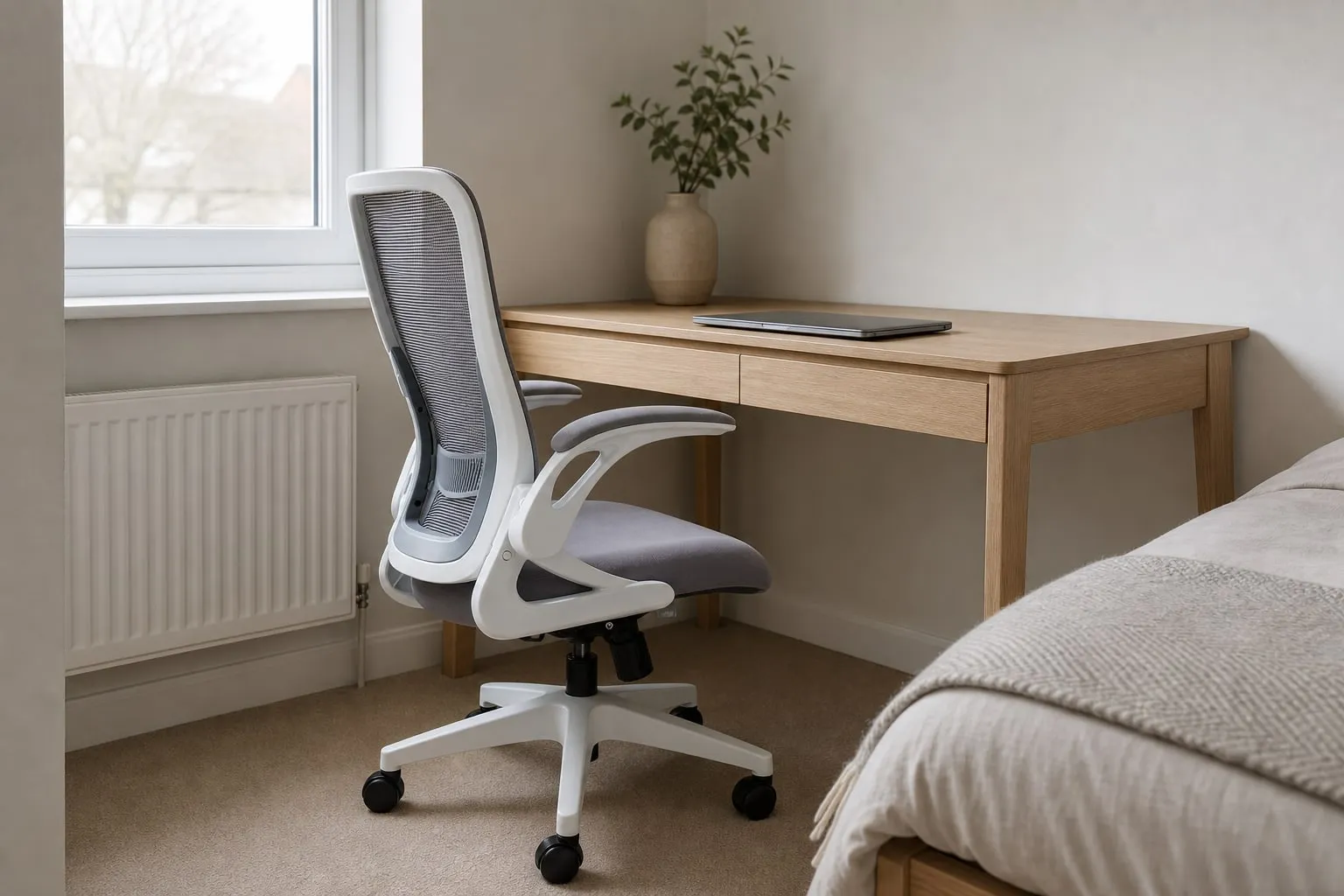
Allow about 75cm from the front edge of the desk to a wall for a chair that can be used normally.
Allow 90cm or more if someone needs to walk behind the chair while it is occupied. In a main household route, 100 to 120cm feels far less cramped.
Those are planning numbers, not building rules. Your chair, body, desk and room layout decide the real fit.
The three measurements that matter
1. Parked depth
This is the distance from the desk front to the back of the chair when it is tucked in.
A chair with flip-up arms may park closer than one with fixed arms. A folding-back chair such as the Tervo Model U can sit lower under a compatible desk.
The wheelbase can still project beyond the seat, so measure at floor level as well as desktop height.
2. Working depth
This is the distance needed when you are seated in a normal typing position.
For many setups, 60 to 75cm from the desk front is a useful starting range. A deeper seat, reclined posture or larger user may need more.
3. Exit depth
You need to move the chair back far enough to stand.
This is often the largest measurement. A chair that technically fits while occupied can still trap the user between desk and wall.
A simple room calculation
Add:
- the desk depth
- the chair space from the desk front
- any route needed behind the chair
For example:
- 50cm desk depth
- 75cm chair zone
- no route behind
Total: 125cm from the wall to the back of the usable chair zone.
If a 60cm walking route must remain behind the occupied chair, the total becomes 185cm.
Bedroom example
Imagine a 240cm-wide bedroom with a 135cm double bed.
That leaves 105cm before allowing for skirting boards, bedding overhang and the desk. A 40cm-deep desk leaves roughly 65cm for the chair gap. That can work for a compact chair, but it will feel tight and the bed may block a comfortable exit.
In that room, a folding desk or a chair that parks fully underneath can improve the space when work is finished. It does not create more room while someone is sitting.
Chair features that help
Flip-up arms
These remove a common collision with the desktop. See the best office chairs with flip-up arms.
Folding back
A folding back reduces parked height and can let the chair move under the desk. See the best folding office chairs.
Armless design
No arms means fewer desk collisions, but armless chairs are not always narrow. The HOMCOM cross-legged chair has a 65cm-wide seat.
Smaller wheelbase
A compact base can save floor space, but it must remain stable. Do not choose a chair solely because the wheels look close together in a photo.
Desk features that make clearance worse
Check for:
- drawers under the top
- low crossbars
- modesty panels
- cable trays
- thick aprons around the desktop
- narrow gaps between leg frames
A 100cm desktop can have less chair clearance than a simple 80cm desk if storage fills the underside.
What if a door opens into the chair?
Treat the door swing as unavailable space. Do not plan to move the chair every time the door opens, especially if it is the room’s only exit.
The same applies to wardrobe doors and drawers. Sliding wardrobe doors are easier, but you still need standing room to use them.
Mark the desk, chair and door swing on the floor with low-tack tape. Sit on a dining chair or stool in the planned position and try the route. Five minutes of awkward shuffling tells you more than a perfect floor-plan sketch.
Do you need a route behind the chair?
If the desk faces a wall and nobody passes behind, 75cm may be enough for normal use.
If the chair sits in a route to a wardrobe, window or side of the bed, aim for at least 90cm from desk front to obstruction. More is better when the route is used frequently.
For wheelchair access or specific mobility needs, use the relevant accessibility guidance and measure around the individual user and equipment. General furniture rules are not enough.
The practical answer
Start with 75cm behind the desk for the chair alone. Use 90cm or more where someone must pass. Then test the exact chair, desk opening and exit movement.
In a compact room, the best setup is not the one with the smallest product dimensions. It is the one that preserves the route the room needs every day.
Where to go next
Continue from this article into the most relevant compact setup guides, reviews, and hubs.
Folding chair
Tervo Model U Review
See how a folding back changes parked clearance without shrinking the wheelbase.
Read next
Room layout
Small Bedroom Desk Setup Ideas
Plan the chair route alongside the bed, wardrobe and door swing.
Read next
Hub
Small desk hub
Start with compact desk reviews and guides grouped by room size and setup type.
Read next
Hub
Small office chairs hub
Compare chairs for small desks, bedroom corners, and tuck-away setups.
Read next